

How Etherquil Token Is Transforming Education, Credentials and Careers with Web3
Traditional education is under pressure. Diplomas are expensive, slow to obtain, easy to fake and hard to verify. Online courses have exploded, but they remain fragmented, with closed platforms and certificates that employers rarely trust. At the same time, the job market is moving faster than ever, demanding verifiable, up-to-date skills rather than generic degrees. Etherquil Token is designed as a Web3-native answer to this problem: a utility token powering an open ecosystem for on-chain credentials, learn-to-earn education models and direct connections between learners, educators and employers.
Instead of treating education as a one-time event that ends with a paper diploma, Etherquil aims to make skills, achievements and learning history persistent, verifiable and portable across platforms. The token functions as the economic backbone of this new ecosystem, enabling payments, incentives, governance and credential issuance in a transparent and programmable way.
Why Traditional Education and Credentials Are Broken
For decades, the default path to proving competence has been simple: get a degree, show a certificate, hope recruiters believe it. This model no longer scales. Diplomas are slow and expensive, often out of sync with rapidly evolving industries like technology and digital marketing. Verification is manual and time-consuming, requiring calls to institutions or third-party background checks. In parallel, the rise of online education has created thousands of platforms with their own closed certificate systems, none of which interoperate or share standards.
Self-taught developers, designers and data analysts often have strong skills but no formal proof of competence. Recruiters must rely on résumés, portfolios and interviews that are easy to embellish but hard to validate objectively. Employers want a reliable, global way to verify skills; learners want credentials that are trusted internationally, not just inside a single platform or country. The gap between what education provides and what the labor market needs continues to widen.
The Origin Story of Etherquil Token
Etherquil Token was conceived by a team of EdTech entrepreneurs, HR specialists and Web3 developers who had spent years building online courses, corporate training programs and recruitment tools. They kept running into the same set of problems:
- Educational platforms were siloed, each with its own proprietary certificates.
- Verifying a candidate’s skills required manual work, even when they had completed high-quality online courses.
- Students and instructors depended on centralized platforms that controlled pricing, access and revenue sharing.
The founding idea behind Etherquil was straightforward: combine the openness and verifiability of blockchain with the richness of modern online education. Instead of issuing certificates locked inside one platform, why not record learning achievements on-chain in a standardized, tamper-resistant format? And instead of simple one-way payments for courses, why not design a token economy that rewards both learning and teaching, while giving employers tools to validate skills at scale?
Etherquil Token was created as the economic engine for this ecosystem—a utility token that fuels credential issuance, course payments, incentive programs and community governance.
What Is Etherquil Token?
Etherquil Token is a utility token for a Web3 education and certification platform that connects learners, educators, course providers and employers in a single on-chain ecosystem. It is not just a payment coin; it is the glue that ties together identity, credentials, incentives and governance.
Key roles of Etherquil Token include:
- Payment medium: used to pay for courses, exams, certification services and value-added tools.
- Incentive layer: distributed as rewards in learn-to-earn programs when learners complete modules, pass assessments and build real projects.
- Credential fuel: required to mint, update and manage on-chain credentials and educational NFTs.
- Governance token: grants voting rights in the educational DAO that steers standards, funding and ecosystem evolution.
Technically, Etherquil is designed to live on an EVM-compatible network, with an emphasis on low-fee Layer 2 environments to keep transactions cheap enough for mainstream educational use (e.g. credential minting and micro-rewards).
On-Chain Credentials: Verifiable Skills and Diplomas
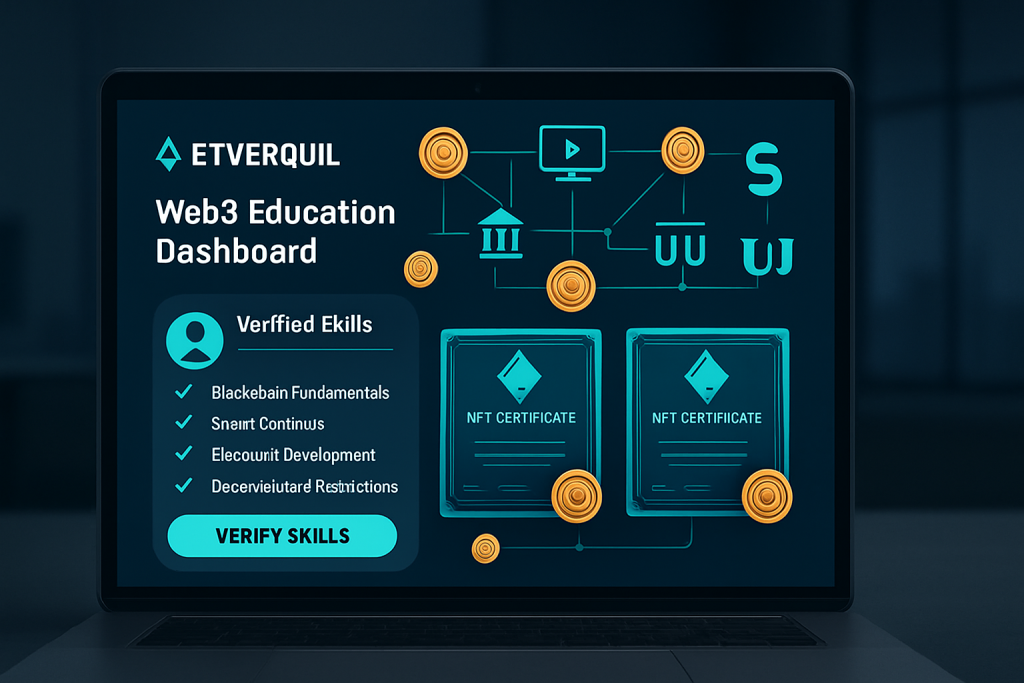
At the heart of Etherquil is the concept of on-chain credentials. Instead of issuing a PDF certificate or image file that can be forged, each completed course, exam or skill is recorded as an entry on the blockchain, often represented as a non-transferable NFT (sometimes called a “soulbound” token).
These credentials can include:
- The course or program name and issuing organization.
- The competencies or learning outcomes achieved.
- Assessment results, project submissions or portfolio links.
- Timestamps and versioning information for re-certifications.
Because the data is on-chain, any employer, platform or recruiter can verify the authenticity of a credential by querying the blockchain. They can check that it was indeed issued by a recognized provider and that it belongs to the candidate’s address. Privacy is handled through selective disclosure: some credentials may be fully public, while others can be shared only via cryptographic proofs or with explicit learner consent.
Etherquil Token powers this system by acting as the “gas” for credential operations—issuers need it to mint new credentials, update existing ones or revoke outdated records. This ensures that the credential layer remains sustainable and spam-resistant.
Learn-to-Earn: Incentivizing Real Skill Acquisition
One of the biggest criticisms of traditional education is misaligned incentives: students pay up front, but there is no guarantee of practical skills or job outcomes. Etherquil introduces a learn-to-earn model designed to reward verifiable learning rather than mere enrollment.
In this model:
- Learners receive Etherquil rewards when they complete validated modules, pass proctored exams or submit projects that meet predefined criteria.
- Portions of these rewards can be sponsored by ecosystem funds, corporate partners or foundations interested in upskilling particular populations or regions.
- Rewards are tied to outcomes: no completion, no token. This encourages real engagement rather than passive consumption.
The goal is not to create speculative farming of tokens, but to nudge behavior toward consistent, high-quality learning. Well-designed courses that lead to verifiable skills and employment outcomes can be prioritized in reward distribution, while superficial content receives less or no incentive support.
Educator and Course Marketplace
To make the ecosystem vibrant, Etherquil Token supports an open marketplace of courses, programs and learning experiences:
- Individual instructors, training firms and institutions can publish their own courses.
- They set prices in Etherquil, define assessment methods, and specify what credentials will be issued upon completion.
- Learners can browse offerings, comparing not just marketing text but on-chain metrics: completion rates, learner feedback, and post-course employment indicators where available.
Payments flow in Etherquil, with programmable splits:
- A portion goes to the course creator or institution.
- A portion may go to the platform for infrastructure and support.
- Another portion can be routed to ecosystem funds that sustain scholarships, audits and standardization work.
High-performing educators—those whose learners succeed and maintain strong credential reputations—can receive additional rewards from ecosystem incentive pools, aligning revenue with educational impact.
Skill Verification for Employers
For employers and recruiters, Etherquil Token and its credential network address a major pain point: reliable skill verification at scale.
In a typical flow:
- A candidate shares their wallet address or a cryptographic proof linked to their on-chain profile.
- The employer’s systems (or a dedicated Etherquil dashboard) read the candidate’s verified credentials: courses completed, skills certified, practical projects delivered.
- Recruiters can filter candidates based on combinations of credentials, completion dates, issuing institutions and even performance metrics in specific assessments.
- If needed, employers can commission custom tests or capstone projects, paying in Etherquil and automatically recording successful results as new credentials.
This dramatically reduces the time and cost associated with verifying education claims. It also opens the door for talent from non-traditional backgrounds—self-taught developers, bootcamp graduates, career switchers—to demonstrate their competence on equal footing with traditional degree holders.
Scholarship DAO and Funding Mechanisms
To support accessibility, Etherquil includes a Scholarship DAO funded by a share of token issuance and ecosystem fees. The goal: channel resources into education that has the highest social and economic impact.
Mechanisms can include:
- Regular proposal cycles where learners, educators or NGOs submit scholarship or grant ideas.
- Token holders vote on which initiatives to fund, prioritizing topics like STEM, climate tech, healthcare, cybersecurity, or underserved communities.
- Approved programs receive Etherquil allocations to cover course fees, learning materials, devices or living stipends where appropriate.
This creates a community-driven funding model. Instead of centralized institutions deciding which disciplines and demographics deserve support, the entire ecosystem can steer capital toward areas where education can change lives and economies.
Token Utility and Tokenomics Overview
The value of Etherquil Token comes from its concretely defined utilities within the education ecosystem:
Core utilities:
- Payments for courses, exams, verification services and premium features on integrated platforms.
- Rewards for learners in learn-to-earn structures based on verifiable progress.
- Credential operations such as minting, updating or revoking on-chain records.
- Staking by educators, institutions and corporate partners to signal commitment, unlock higher visibility or gain governance weight.
- Governance rights in the DAO that sets standards and allocates ecosystem funds.
Economic principles:
- A limited or tightly controlled supply prevents uncontrolled inflation, helping preserve long-term value.
- Distribution balances several needs: team and early contributors (with long vesting), community rewards, ecosystem funds (including the Scholarship DAO) and liquidity.
- A fee recycling or burn mechanism can remove a fraction of transaction or credential fees from circulation, coupling token scarcity with ecosystem growth.
- Incentive schedules are designed to favor genuine, high-quality education rather than short-term speculation.
The result is a token whose demand is tied to real-world actions—learning, teaching, credentialing and hiring—rather than purely financial engineering.
Governance and Community Role
Decentralized governance is central to Etherquil’s long-term resilience. Etherquil Token holders can participate in decision-making across several critical dimensions:
- Credential standards: defining required fields, validity periods, re-certification rules and interoperability formats.
- Provider accreditation: setting criteria for which institutions or educators can issue certain types of credentials (e.g. “verified” vs. “community” badges).
- Incentive structures: adjusting learn-to-earn parameters to minimize abuse and maximize genuine educational value.
- Scholarship DAO priorities: deciding which fields, regions or learner groups receive funding focus.
In practice, this can be implemented via on-chain proposals and voting. Large stakeholders—such as major education providers, corporate partners and long-term learners—are incentivized to align their votes with the health of the ecosystem, because the value of their holdings depends on Etherquil’s credibility and adoption.
Use Cases: Students, Educators, Employers
For students and lifelong learners:
- Enroll in courses across multiple platforms that support Etherquil and earn on-chain credentials recognized beyond a single website.
- Receive Etherquil rewards for completing rigorous coursework, not just for signing up.
- Build a portable, verifiable skills profile that can be presented to employers anywhere in the world.
For educators and institutions:
- Publish courses independently, accept Etherquil payments without relying on a single centralized platform.
- Gain access to global learners who value interoperable, on-chain credentials.
- Receive bonus rewards when learners complete programs and achieve positive career outcomes.
For employers and recruiters:
- Integrate Etherquil’s credential graph into applicant tracking systems, enabling fast, automated skill verification.
- Design custom assessment tracks or corporate academies where successful completion is recorded on-chain.
- Reduce time-to-hire and fraud risk by relying on verifiable, tamper-resistant credentials rather than unverifiable claims.
Risks and Challenges
As with any emerging model, Etherquil Token faces a set of risks and challenges that participants should understand:
- Regulatory uncertainty: token-based educational services and scholarship funding may fall under different regulations across jurisdictions (securities, data protection, financial aid rules).
- Quality control: an open marketplace of courses can attract low-quality providers; without strong standards and ratings, the signal-to-noise ratio can suffer.
- Incentive gaming: poorly designed reward schemes may encourage learners to “farm” tokens with minimal real learning, undermining the system’s credibility.
- Institutional inertia: traditional universities and accreditation bodies may resist integrating with or recognizing on-chain credentials.
Mitigation strategies include robust provider accreditation, multi-layered reputation systems, periodic audits of course outcomes, anti-cheating mechanisms for assessments, and proactive dialogue with regulators and established institutions.
Roadmap and Future Vision for Etherquil
The Etherquil roadmap can be structured into several phases:
Phase 1: Core Infrastructure and Early Adopters
- Launch of the Etherquil Token and basic credential smart contracts.
- Integration with a small group of pilot education partners (e.g. coding bootcamps, online academies).
- Initial learn-to-earn experiments with limited reward pools.
Phase 2: Ecosystem Growth
- Expansion of the course marketplace with diverse providers (tech, design, business, language learning).
- Roll-out of employer tools for credential verification and custom assessments.
- Launch of the Scholarship DAO with transparent, community-driven funding cycles.
Phase 3: Corporate and Institutional Adoption
- Integration with corporate L&D (Learning & Development) systems for internal training and upskilling.
- Partnerships with forward-looking universities and vocational institutions to issue dual on-chain and traditional credentials.
- Development of advanced analytics for tracking the impact of education on career outcomes.
Phase 4: Global Standard for Skills Credentials
- Position Etherquil as a widely recognized standard for digital skills verification.
- Enable direct wallet-based applications where candidates share verifiable portfolios instead of static résumés.
- Foster a global market where education is evaluated by skill outcomes and transparency rather than brand alone.
The long-term vision is ambitious: to make Etherquil Token and its credential ecosystem a default layer for proving skills and achievements in the digital economy.
How to Get Started with Etherquil
For learners:
- Create a compatible Web3 wallet and link it to an Etherquil-enabled learning platform.
- Enroll in your first course that issues on-chain credentials.
- Complete modules and assessments to start building a visible, verifiable skills profile.
- Claim any available Etherquil rewards and learn how to manage them securely.
For educators and platforms:
- Review Etherquil’s technical documentation and integration guides.
- Decide which courses and programs will issue on-chain credentials and what data they include.
- Integrate payment and credential minting flows into your existing platform.
- Participate in governance to help shape standards and scholarship priorities.
For employers:
- Pilot Etherquil-based skill verification with a subset of roles or candidates.
- Integrate credential checks into existing applicant tracking or HR systems.
- Explore creating branded learning paths or internal academies where successful completion generates Etherquil-backed credentials.
By aligning incentives across learners, educators and employers, Etherquil Token aims to turn education from a static, opaque credentialing system into a living, verifiable and continuously evolving skill network.